
My time living in Saudi Arabia
Having worked alongside many Saudi nationals during the Royal Greens project is is fitting I include a reference (thanks to Wikipedia) on their ancestors of which they are rightly proud.
The Bedouin (/ˈbɛdᵿ.ɪn/; Arabic: بَدَوِي badawī) is a recent term in the Arabic language that is used commonly to refer to the people (Arabs and non-Arabs) who live, or have descended from tribes who lived, stationary or nomadic lifestyles outside cities and towns. The term contrasts against ‘Hathar’ (“حضر”) which refers to the city or town dwellers in the Arabic language. Bedouin means “Badiyah dwellers” in the Arabic language, as ‘Badyah’ means literally the visible land (the desert).[10] The Bedouins identify themselves as Arabs or by the names of their tribes. City dwellers in Arabia who descended from known tribes refer to themselves as Bedouins to recognize their native origin to Arabia. The term has lost exact meaning; it is sometimes used in racial profiling, and it is commonly mixed with another term “A-araab” “” which is mentioned in Quran in reference to unruly tribesmen who do not follow the lifestyle codes of bedouin tribes or city dwellers. Bedouin territory stretches from the vast deserts of North Africa to the rocky sands of the Middle East.[10] They are traditionally divided into tribes, or clans (known in Arabic as ʿashāʾir; عَشَائِر) and share a common culture of herding camels and goats.[10]
The Bedouin form a part of, but are not synonymous with, the modern concept of the Arabs.[citation needed] Bedouins have been referred to by various names throughout history, including Qedarites in the Old Testament and Arabaa by the Assyrians (ar-ba-a-a being a nisba of the noun Arab, a name still used for Bedouins today). They are referred to as the Araab (أعراب) in the Koran.
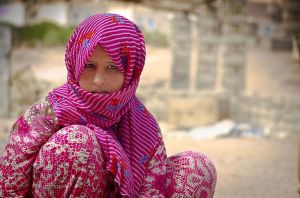
A Bedouin girl in Nuweiba – Egypt 2015
While many Bedouins have abandoned their nomadic and tribal traditions for modern urban lifestyle, they retain traditional Bedouin culture with concepts of belonging to ʿašāʾir, traditional music, poetry, dances (like Saas), and many other cultural practices. Urbanised Bedouins also organise cultural festivals, usually held several times a year, in which they gather with other Bedouins to partake in, and learn about, various Bedouin traditions—from poetry recitation and traditional sword dances, to classes teaching traditional tent knitting and playing traditional Bedouin musical instruments. Traditions like camel riding and camping in the deserts are also popular leisure activities for urbanised Bedouins who live within close proximity to deserts or other wilderness areas.