
Employed by Desert Group UAE as the Project Manager for the Sir Nick Faldo designed Rumanza project in Multan, Pakistan.
KAEC Completes Award-Winning Year With Global Win at International Property Awards

Posted in Latest News
Leave a comment
My time living in Saudi Arabia
Having worked alongside many Saudi nationals during the Royal Greens project is is fitting I include a reference (thanks to Wikipedia) on their ancestors of which they are rightly proud.
The Bedouin (/ˈbɛdᵿ.ɪn/; Arabic: بَدَوِي badawī) is a recent term in the Arabic language that is used commonly to refer to the people (Arabs and non-Arabs) who live, or have descended from tribes who lived, stationary or nomadic lifestyles outside cities and towns. The term contrasts against ‘Hathar’ (“حضر”) which refers to the city or town dwellers in the Arabic language. Bedouin means “Badiyah dwellers” in the Arabic language, as ‘Badyah’ means literally the visible land (the desert).[10] The Bedouins identify themselves as Arabs or by the names of their tribes. City dwellers in Arabia who descended from known tribes refer to themselves as Bedouins to recognize their native origin to Arabia. The term has lost exact meaning; it is sometimes used in racial profiling, and it is commonly mixed with another term “A-araab” “” which is mentioned in Quran in reference to unruly tribesmen who do not follow the lifestyle codes of bedouin tribes or city dwellers. Bedouin territory stretches from the vast deserts of North Africa to the rocky sands of the Middle East.[10] They are traditionally divided into tribes, or clans (known in Arabic as ʿashāʾir; عَشَائِر) and share a common culture of herding camels and goats.[10]
The Bedouin form a part of, but are not synonymous with, the modern concept of the Arabs.[citation needed] Bedouins have been referred to by various names throughout history, including Qedarites in the Old Testament and Arabaa by the Assyrians (ar-ba-a-a being a nisba of the noun Arab, a name still used for Bedouins today). They are referred to as the Araab (أعراب) in the Koran.
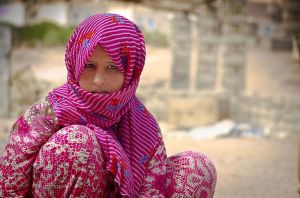
A Bedouin girl in Nuweiba – Egypt 2015
While many Bedouins have abandoned their nomadic and tribal traditions for modern urban lifestyle, they retain traditional Bedouin culture with concepts of belonging to ʿašāʾir, traditional music, poetry, dances (like Saas), and many other cultural practices. Urbanised Bedouins also organise cultural festivals, usually held several times a year, in which they gather with other Bedouins to partake in, and learn about, various Bedouin traditions—from poetry recitation and traditional sword dances, to classes teaching traditional tent knitting and playing traditional Bedouin musical instruments. Traditions like camel riding and camping in the deserts are also popular leisure activities for urbanised Bedouins who live within close proximity to deserts or other wilderness areas.
Posted in Blog
Leave a comment
Saudi Arabia Update
After 2 years working in Saudi Arabia the Royal Greens project is completed and handed over to the client, Emaar. Opening is scheduled for the first quarter of 2017.
Posted in Latest News
Leave a comment
My time living in India
It was a privilege to be part of the largest democratic election in the history of the world during my time living in India.
The Indian general election of 2014 was held to constitute the 16th Lok Sabha, electing members of parliament for all 543 parliamentary constituencies of India. Running in nine phases from 7 April to 12 May 2014, this was the longest election in the country’s history.[3][4]
According to the Election Commission of India, 814.5 million people were eligible to vote, with an increase of 100 million voters since the last general election in 2009,[5] making this the largest-ever election in the world.[6] Around 23.1 million or 2.7% of the total eligible voters were aged 18–19 years.[7]
A total of 8,251 candidates contested for the 543 Lok Sabha seats.[8] The average election turnout over all nine phases was around 66.38%, the highest ever in the history of Indian general elections.[8]
Posted in Blog
Leave a comment
Rice padi fields in Vietnam
Driving to site, through rural, Central Vietnam my attention is turning to an important aspect of our project-the re-introduction of traditional, working Rice Padi fields. Our intention is to turn the allocated land back over to the local villagers for them to once again use the land bordering several golf holes as a functioning, profitable rice crop area. We will also have the benefit of great features travelling the length of several holes where, we hope, traditional farming techniques can be observed as part of the golf experience.
Thanks to Wikepedia I have added a short history of rice farming in Vietnam-
Rice fields in Vietnam (ruộng, cánh đồng or điền in Vietnamese) are the predominant land use in the valley of the Red River and the Mekong Delta. In theRed River Delta of northern Vietnam, farmers must dam up (nowadays 3000 km long) against the annual flood, and it is also the necessary condition to form an alliance among Vietnamese ancient tribals to found Vietnamese people‘s first state. In the Mekong Delta of southern Vietnam, there is an interlacing drainage and irrigation canal system that has become the symbol of this area and impacts on the lifestyle of local people. In Northwestern Vietnam, Thai people built their “valley culture“ based on the economic foundation of glutinous rice upland fields.
The primary festival related to rice fields is “lễ hạ điền” (Vietnamese)/“lồng tồng” (Tay language) in the first day of every crop wishing for yield more than usual. In the past, this was the official national ceremony that the King would make the first plough and people would worship Than Nong (god of agriculture), thổ địa (god of the soil), thành hoàng làng (god of the village), and thần lúa (god of rice plants).
During the Trần Dynasty, there were three kinds of rice field: ruộng quốc khố (national budget rice field) with 3 levels, ruộng thác điền with 3 levels (the name derives from a story about Lê Phụng Hiểu. He refused the King’s present for his feat of arms but required that how far he would throw his knife would be how wide of a rice field he could possess. Since then, it’s become the name of rice field for rewarding Vietnamese mandarins: thác đao- abbreviation: thác- throw the knife and điền- rice field), and ruộng ao of the common people.
In Vietnamese literature, a rice field is described as wide enough for a flock of storks to span their wings across: “đồng lúa thẳng cánh cò bay” and the sway of rice plants in the wind is compared to waves of the sea and called “sóng lúa“. These images are very common phrases describing the beauty of the Vietnamese landscape.
Have you ever considered the maths involved in Padi field farming? Malcolm Gladwells book ‘Outliers’ gives you an amazing insight into Asian culture, maths excellence and work ethic. An extract below, but please read the book!
A great point Gladwell makes is that cultures with a history of rice cultivation also have high levels of diligence. Because rice is so labor-intensive on plots far smaller than corn or wheat for example, rice farmers have been forced to increase yields by being smarter and more innovative. As Gladwell writes:
“Working in a rice field is ten to twenty times more labor intensive than working on an equivalent size corn or wheat field.”
Because rice cultivation forces greater innovation, the nature of the work is far more challenging and complex. It’s also more meritorious, because the harder you work, the greater the harvest. That’s why strict feudalism or slavery doesn’t work with rice cultivation, Gladwell writes,
Finally, a Chinese proverb connected to Rice production- ‘No one who can rise before dawn 360 days a year fails to make his family rich.’
Posted in Blog
Leave a comment
Ordanance and Snakes
Vietnam is one of the many countries plagued by perilous
landmines and UXO. During the Vietnam War (1959–1975)—and to a lesser extent in
other conflicts in the region—landmines were used in border conflicts to
threaten the enemy and 30 years later continue to threaten the country.
Approximately 350,000 to 800,000 tons of landmines and UXO
are leftover from the Vietnam War. There may be as many as 3.5 million
landmines in Vietnam, affecting all 61 provinces in the country. Between 1975
and 2000, Vietnam officials recorded 104,701 mine/UXO casualties killing over
38,000 people. Currently, casualty rates number between 1,200 and 3,000 people
a year. According to Chuck Meadows, the executive director of PeaceTrees
Vietnam, “UXO accidents come mainly from farming, scrap-metal collecting and
meddling with the ordnance items.”1 From 1975 to 2002, the Vietnam
army cleared 1.2 billion square meters (463.32 square miles) of land and
destroyed four million landmines and eight million items of UXO. The majority
of these mines are located in Quang Tri, Quang Binh and Thua Thien-Hue
provinces, located in central and south Vietnam.
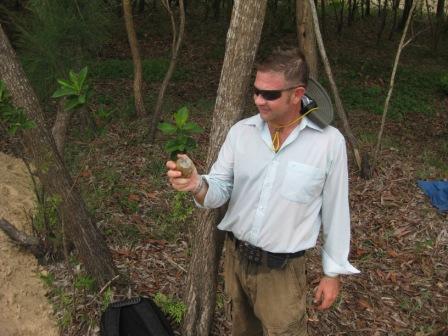
The author below with an excavated Grenade on site…
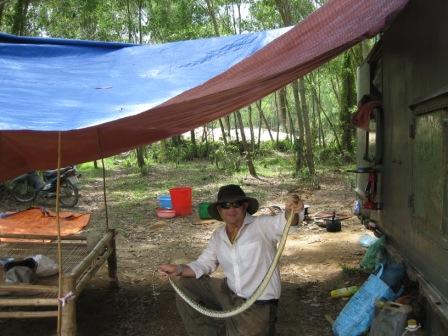
Snakes. US soldiers in the American War used to say that there are 100 types of snakes in Vietnam—99 were poisonous, and the last one could crush you to death. The real numbers are more like 140 species, around 30 of which are poisonous…
The author below with a snake on site….
Posted in Blog
Leave a comment
Working as a General Manager in India
After 18 months in India as General Manger on the DLF owned Gary Player designed projects the grassing completion means it is time to look for new opportunities.
Posted in Latest News
Leave a comment
Shaping and detail works
Shaping and detail works have been completed on 14 holes. Lake construction and the remaining golf construction works are in progress.
Project completion is scheduled for June 2012.
Posted in Latest News
Leave a comment
Partial Bulk Earthworks are under way in Vietnam.
Partial Bulk Earthworks are under way in Vietnam.
A comprehensive tender package of 238,000m3 of earth works, including shaping, river diversions, river widening and engineering will put the project on a firm footing.
Posted in Latest News
Leave a comment